TerminalReviewGet 35% Terminal Cashback
Independent comparison · Updated 2026

Terminal vs Axiom (2026): Which One Should You Choose?

Two of the fastest Solana memecoin trading platforms, compared feature by feature.Fees, cashback, Pump.fun support, discovery tools, and who should use which.

TERMINAL

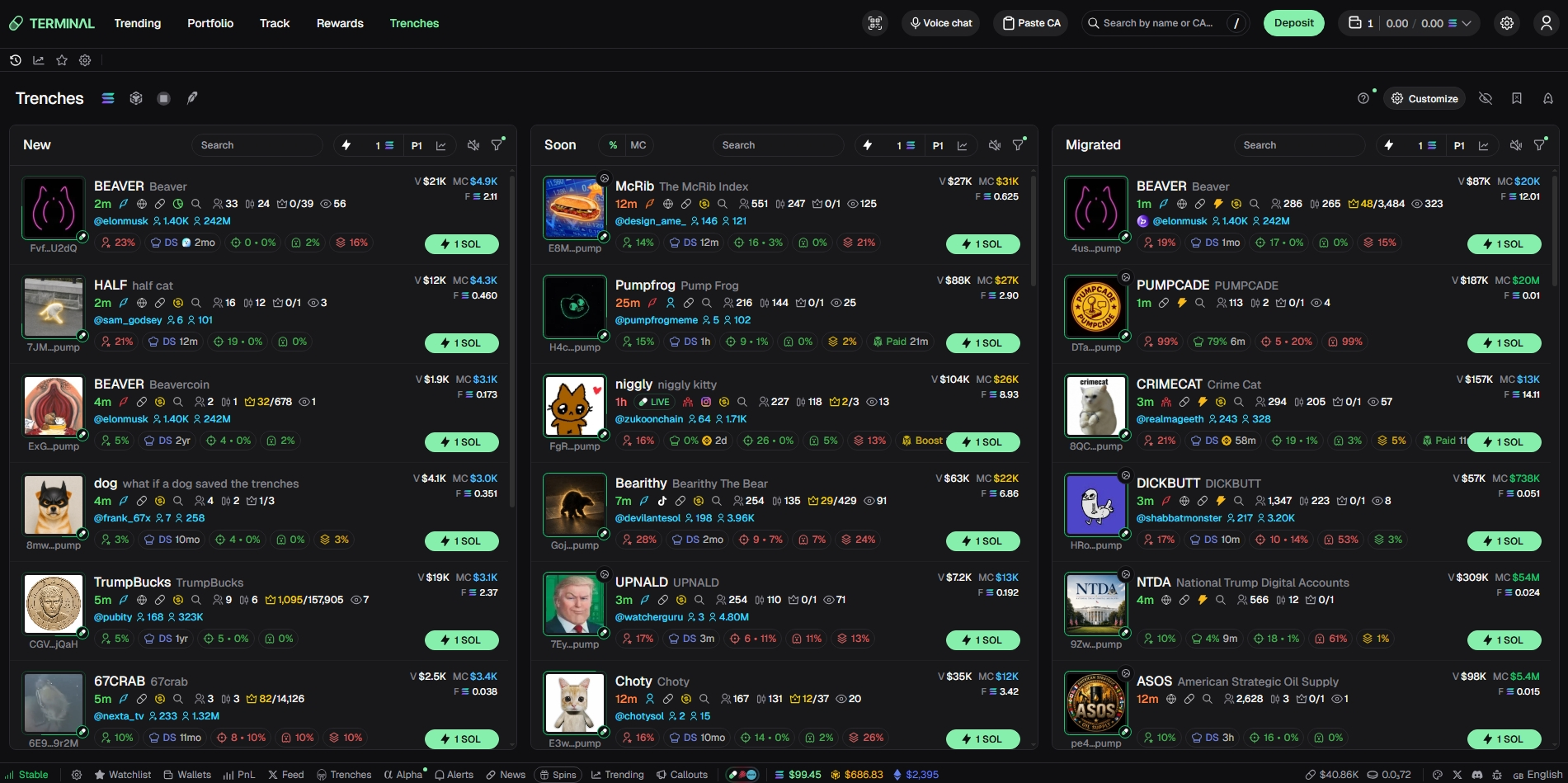
Terminal Pump.fun trading interface with Solana memecoin dashboard, Trenches feed, and advanced trading tools

AXIOM

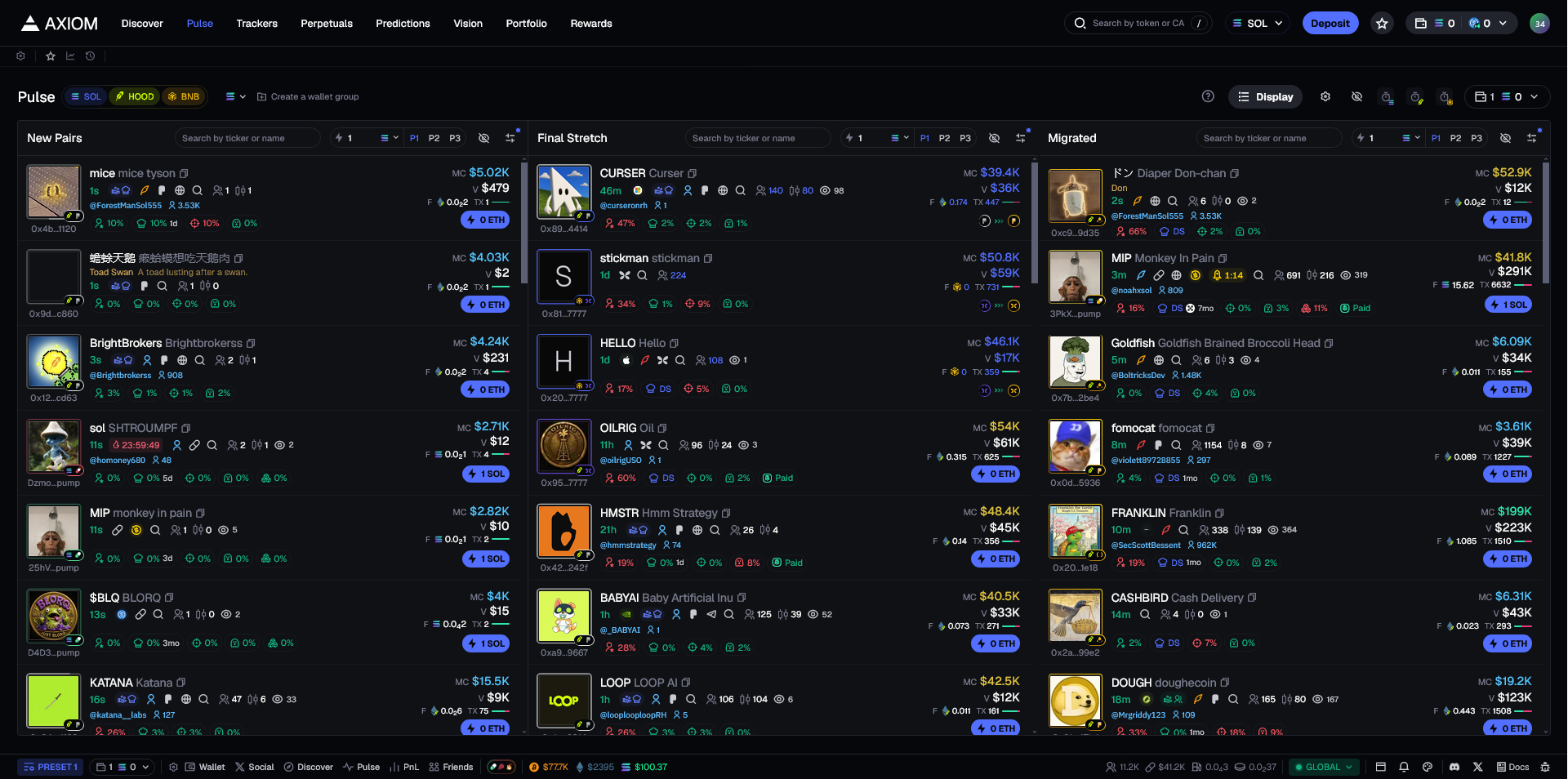
Axiom Solana trading interface with Pulse dashboard, new token discovery feed, and memecoin trading tools

Quick verdict

The short answer

Terminal — Best for Pump.fun, wallet tracking, and multi-chain trading.
Axiom — Best for high-volume Solana trading, perps, and streamer-friendly tools.

Overall winner

Terminal

For Pump.fun-native trading with multi-chain support and 35% referral cashback, Terminal is the stronger all-round pick.

Best for beginners

Terminal

Preset Trenches filters and a simpler workflow make Terminal easier for new Solana traders to learn.

Best for speed traders

Tie

Both platforms are built around low-latency execution. No independent public benchmark separates them, so we call this even.

Best value

Depends on volume

Terminal referral cashback (35% of fees) favors most traders. Axiom high-volume tiers (down to 0.75% net) reward heavy volume.

Best wallet tracking

Terminal

Terminal lets you track and follow top wallets from the Track page, surfacing buys in real time across its multi-chain feed.

Best multi-chain trading

Terminal

Terminal supports Solana, Ethereum, Base, and BNB Chain in one interface. Axiom remains Solana-first with perps via Hyperliquid.

Side by side

Feature comparison table

Verified features only, sourced from official documentation and product pages as of 2026.

Feature comparison between Terminal (formerly Padre) and Axiom
FeatureTerminalAxiom
Base trading fees~0.5% to 1% per trade0.75% to 0.95% net (volume tiers)
Cashback / rebates10% default, 35% via referral linkSOL cashback via tier multipliers, 10% referral discount
Supported chainsSolana, Ethereum, Base, BNB ChainSolana-first (perps via Hyperliquid)
Pump.fun supportNative (built by the Pump.fun team)Yes
Wallet trackingYesYes
Multi-wallet tradingYesYes
Limit ordersYesYes
DCA ordersYes (plus TWAP)Yes
Stop lossYes (incl. trailing stop-loss)Yes
Take profitYesYes
SnipingTrenches launch snipingPulse launch sniping
MEV protectionYesYes
Perpetuals / leverageNot offeredUp to 50x via Hyperliquid
Mobile experienceProgressive web app (PWA)Mobile web (no native app)

Fees, tiers, and cashback programs can change.
Always verify current rates inside each platform before trading.

In depth

Terminal vs Axiom, category by category

Fees and cashback

Terminal charges roughly 0.5% to 1% per trade depending on the trade type, with 10% of fees returned as SOL cashback by default. Signing up through a referral link gives you 35% lifetime cashback. which meaningfully lowers effective costs for active traders.

Axiom uses a volume-tiered model: net fees range from 0.95% at the entry Wood tier down to 0.75% at the Champion tier, with cashback paid in SOL through tier multipliers. Referred users also receive a 10% discount on trading fees. Perpetual trades through Hyperliquid carry a separate 0.01% fee.

For most traders, Terminal referral cashback produces the lower effective cost. Very high-volume Axiom users who reach top tiers can close that gap.

Verdict: Terminal wins on effective cost for most traders via 35% referral cashback; Axiom rewards sustained high volume.

Execution workflow

Terminal is built around fast one-click execution from its Trenches feed, with market, limit, stop-loss, take-profit, buy-dip, DCA, and TWAP order types, plus trailing stop-loss. Optional MEV protection is available in settings (currently not supported on Base).

Axiom pairs its Pulse feed with limit orders, automated take-profit and stop-loss, DCA, and a Sniper feature that auto-buys tokens the moment they migrate from the Pump.fun bonding curve to Raydium. MEV protection offers three modes (Off, Reduced, Secure) routed through Jito bundles.

Both platforms advertise low-latency execution. There is no independent public benchmark that reliably separates them, so we do not rank one as faster.

Verdict: Even. Both offer professional-grade order types and fast execution; Axiom adds migration sniping, Terminal adds TWAP and trailing stops.

Wallet tracking

Axiom still has strong wallet tracking, with monitoring built directly into Pulse and tied into its real-time discovery feed. Keeping tracking and discovery in one view is a genuine strength of the Axiom workflow.

In my experience, Terminal has the better wallet tracking workflow: the dedicated Track page ships with built-in KOL wallets and lets you add and monitor any Solana wallet in real time, surfacing their buys as they happen across the multi-chain feed.

Verdict: Terminal gets the edge overall for its dedicated Track page and built-in KOL wallets, though Axiom remains excellent thanks to tracking baked right into its discovery feed.

Trenches vs Pulse discovery

Terminal Trenches is a real-time feed of new launches with granular, stackable filters — hide spam-heavy launches, require original socials and avatars, restrict to SOL pairs, and more. Because Terminal is built by the Pump.fun team, Trenches is tightly optimized for Pump.fun launch flow.

Axiom Pulse organizes the Pump.fun token lifecycle into stages — New Creations, Final Stretch, and Migrated — and filters by age, liquidity, volume, transaction counts, plus Snipers % and Insiders % metrics.

The two take different approaches: Trenches emphasizes noise removal through quality filters, while Pulse emphasizes lifecycle staging and on-chain participation metrics.

Verdict: Terminal for filter depth and native Pump.fun integration; Axiom for lifecycle staging and sniper/insider metrics. Pick by workflow.

Multi-wallet trading

Both platforms support creating or importing multiple wallets and trading across them. Terminal manages wallets through encrypted private-key infrastructure with a unified interface across its four supported chains. Axiom supports tracking and trading across multiple addresses within its Solana-first terminal.

Verdict: Even on Solana. Terminal is the only option if you want multi-wallet trading across Ethereum, Base, and BNB too.

Supported chains

Terminal supports Solana, Ethereum, Base, and BNB Chain with a consistent interface and order types across all of them.

Axiom is Solana-first. Its perpetuals product connects to Hyperliquid for leveraged trading up to 50x, but spot memecoin trading centers on Solana.

Verdict: Terminal wins for multi-chain spot trading. Axiom wins if you specifically want perps and leverage.

Beginner experience

Both are professional-grade terminals with a real learning curve. Terminal is somewhat friendlier to newcomers: one interface across chains, preset-friendly Trenches filters, and a PWA that works the same on mobile and desktop.

Axiom exposes more raw metrics (Snipers %, Insiders %, tier mechanics) which experienced traders love but beginners may find dense.

Verdict: Terminal is the gentler on-ramp for Pump.fun beginners.

Advanced trader tools

Axiom targets power users: volume-tiered fees, Hyperliquid perps up to 50x, granular MEV modes, and sniper automation on Raydium migration.

Terminal counters with TWAP execution, trailing stop-loss, buy-dip automation, and multi-chain coverage — but it does not offer perpetuals or leverage.

Verdict: Axiom for leverage and tier-driven volume trading; Terminal for advanced spot automation across chains.

Mobile experience

Terminal ships as a progressive web app with full desktop parity on mobile — no app store download needed.

Axiom has no native mobile app; the recommended path is its mobile web interface added to your home screen.

Verdict: Terminal has the stronger, more deliberate mobile experience.

Trade-offs

Pros and cons

Terminal (formerly Padre)

Pros

  • Built by the Pump.fun team with native launch integration
  • 35% lifetime cashback via referral link
  • Multi-chain: Solana, Ethereum, Base, BNB Chain
  • Deep Trenches filters cut launch noise
  • TWAP, trailing stop-loss, and buy-dip automation
  • Full-parity mobile PWA

Cons

  • No perpetuals or leveraged trading
  • Dense interface takes time to learn

Axiom

Pros

  • Volume tiers cut net fees to 0.75% for heavy traders
  • Wallet tracking built directly into Pulse
  • Sniper automation on Pump.fun-to-Raydium migration
  • Perpetuals up to 50x via Hyperliquid
  • Three-mode MEV protection via Jito

Cons

  • Solana-first; no unified multi-chain spot trading
  • No native mobile app
  • Tier system favors high volume; entry tier pays 0.95% net

Recommendations

Who should choose what?

Pump.fun beginners

Terminal

Native Pump.fun integration, preset-friendly Trenches filters, and a single interface to learn make Terminal the natural starting point.

Fast Solana traders

Either

Both execute quickly with pro order types. Choose Terminal for filter-driven discovery, Axiom for lifecycle stages and migration sniping.

Multi-chain traders

Terminal

If you rotate between Solana, Ethereum, Base, and BNB Chain, Terminal is the only one of the two offering a unified multi-chain workflow.

High-volume traders

Compare both

Axiom Champion tier (0.75% net) can beat standard rates at scale. Run the math against Terminal 35% referral cashback for your volume.

New to Terminal?
Start with the full Terminal review and the Trenches filters guide, or our Terminal vs GMGN.AI comparison.

Answers

Terminal vs Axiom FAQ

Is Terminal better than Axiom?

It depends on your workflow. Terminal is the stronger pick for Pump.fun-native trading, multi-chain spot trading (Solana, Ethereum, Base, BNB Chain), mobile use, and 35% referral cashback. Axiom is stronger for Solana-only power users who want volume-tiered fees, wallet tracking inside the Pulse feed, and perpetuals up to 50x via Hyperliquid. Many active traders use both.

Which is cheaper, Terminal or Axiom?

Their base fees are similar (roughly 0.5% to 1% per trade). Terminal returns 10% of fees as cashback by default and 35% via referral link. Axiom uses volume tiers with net fees from 0.95% down to 0.75%, plus a 10% referral discount. For most traders, Terminal referral cashback yields the lower effective cost; very high-volume Axiom users can close the gap at top tiers.

Which is faster, Terminal or Axiom?

Both platforms are engineered for low-latency Solana execution and both advertise speed as a core feature. There is no independent public benchmark that reliably ranks one above the other, so any specific speed claim should be treated with skepticism.

Does Axiom support Pump.fun?

Yes. Axiom Pulse tracks the Pump.fun token lifecycle across stages (New Creations, Final Stretch, and Migrated), and its Sniper feature can automatically buy tokens the moment they migrate from the Pump.fun bonding curve to Raydium.

Is Terminal built by Pump.fun?

Yes. Terminal is built by the team behind Pump.fun. The platform was previously known as Padre and was rebranded to Terminal after the Pump.fun acquisition, keeping the same trading engine and workflow.

Get 35% lifetime cashback on Terminal

If Terminal fits your workflow, you can reduce your trading costs with 35% lifetime cashback on fees. Set it up once and it applies to every trade you make going forward.

Get 35% Terminal Cashback

Always trade responsibly.
Memecoin trading carries significant risk.