TerminalReviewGet 35% Terminal Cashback
Independent comparison · Updated 2026

Terminal vs GMGN.AI (2026): Which One Should You Choose?

Two of the fastest Solana memecoin trading platforms, compared feature by feature.Fees, copy trading, Smart Money tracking, security tools, and who should use which.

Terminal

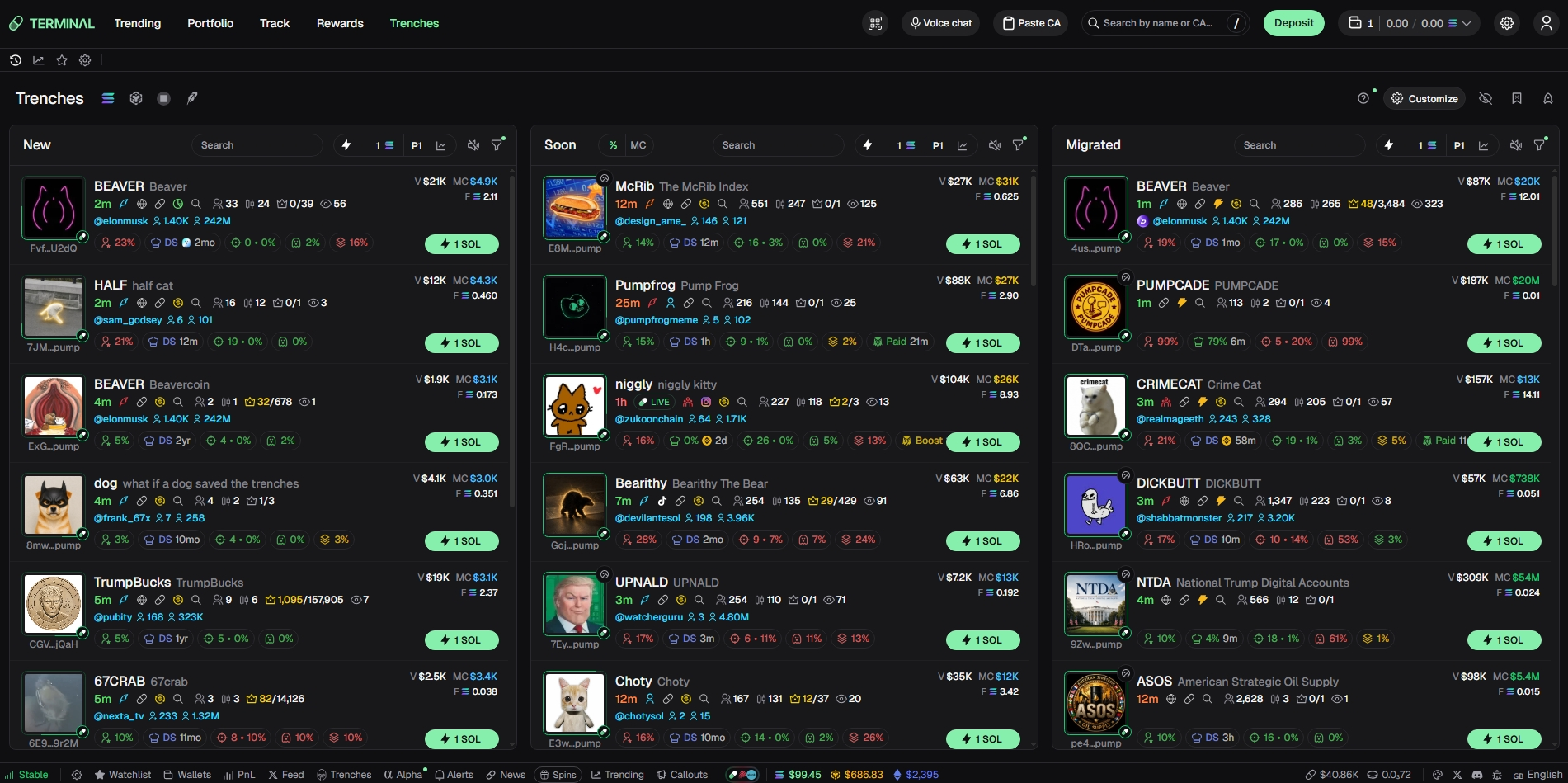
Terminal Trenches interface showing new, soon, and migrated Pump.fun launches

GMGN.AI

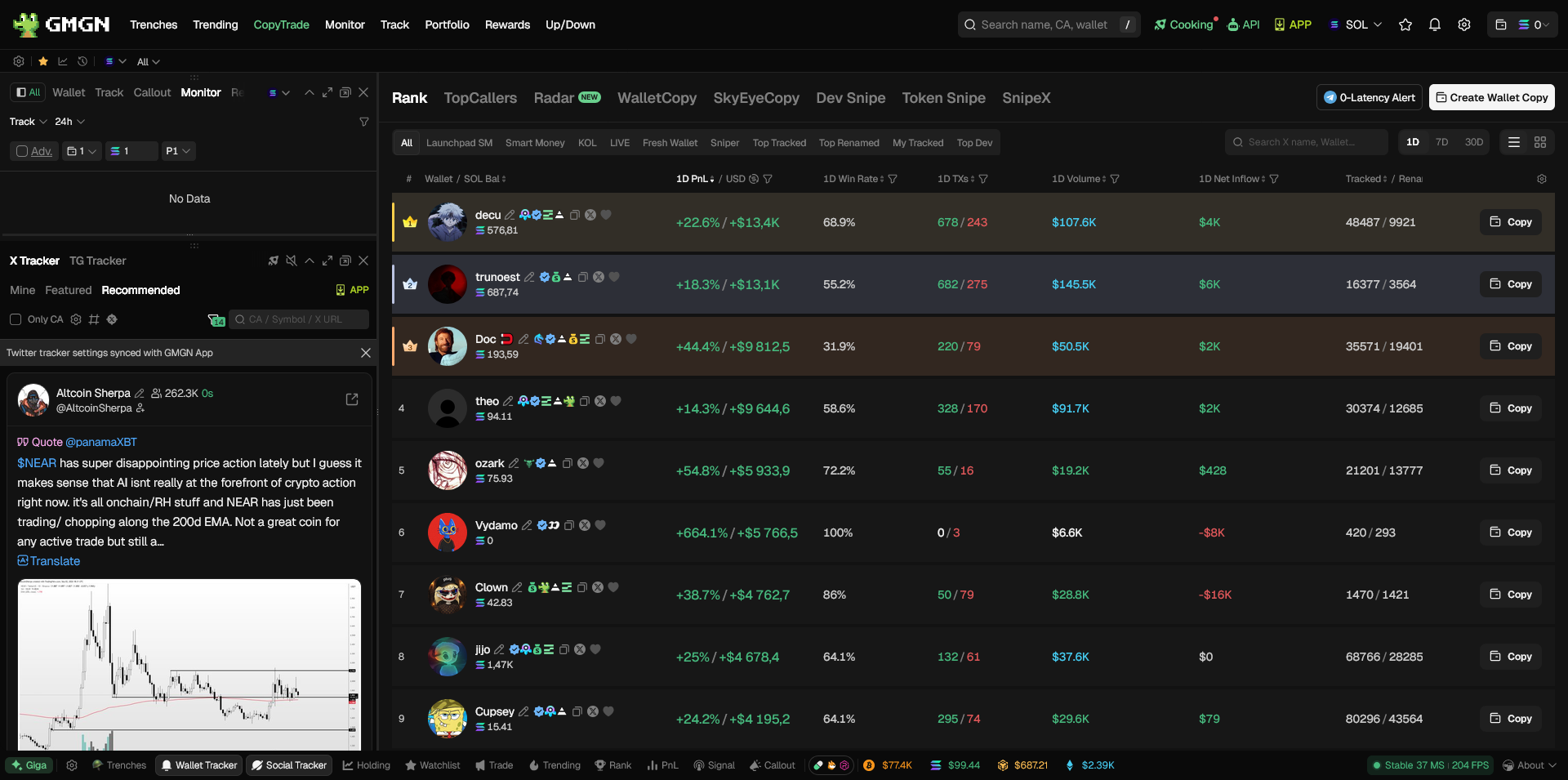
GMGN.AI Smart Money tracking and copy trading interface

Quick verdict

The short answer

Terminal — Best for Pump.fun launches, Trenches discovery, and cashback.
GMGN.AI — Best for copy trading, Smart Money tracking, and security checks.

Overall winner

Terminal

For Pump.fun-native trading with unified multi-chain support and 35% cashback, Terminal is the stronger all-round pick.

Best for beginners

Terminal

Preset Trenches filters and a simpler workflow make Terminal easier for new Solana traders to learn.

Best for speed traders

Tie

Both platforms are built around low-latency execution. No independent public benchmark separates them, so we call this even.

Best value

Terminal

GMGN charges a flat 1% per trade. Terminal is roughly 0.5% to 1% and returns 35% of fees as cashback via referral.

Best copy trading

GMGN.AI

GMGN one-click Smart Money copy trading mirrors a target wallet buys and sells automatically. Terminal has no equivalent.

Best security tooling

GMGN.AI

GMGN runs automated CA security checks on every token, including mint authority, LP burn, blacklist, and rug probability.

Side by side

Feature comparison table

Verified features only, sourced from official documentation and product pages as of 2026.

Feature comparison between Terminal (formerly Padre) and GMGN.AI
FeatureTerminalGMGN.AI
Base trading fees~0.5% to 1% per tradeFlat 1% per trade
Cashback10% default, 35% via referral link10-15% cashback
Supported chainsSolana, Ethereum, Base, BNB ChainSolana, Ethereum, Base, BSC
Pump.fun supportNative (built by the Pump.fun team)Yes, supports Pump.fun tokens
Wallet trackingDedicated Track page with KOL walletsKOL & wallet tracker with real-time alerts
Smart Money trackingNoYes, core feature with live alerts
Copy tradingYes, manualYes, one-click (Solana only)
Multi-wallet tradingYesYes
Limit ordersYesYes
Take profit / Stop lossYes (incl. trailing stop-loss)Yes, multiple TP/SL plus trailing
DCA ordersYes (plus TWAP)Yes
SnipingTrenches launch snipingTelegram Sniper Bot with auto-buy
MEV protectionYesYes
Telegram botOnly for loginYes, Sniper Bot and Alert Bot
Public trading APINot documentedYes, data and trade execution API
Mobile experienceProgressive web app (PWA)Native iOS and Android apps

Fees, rebates, and feature availability can change.
Always verify current rates inside each platform before trading.

In depth

Terminal vs GMGN.AI, category by category

Fees and cashback

Terminal charges roughly 0.5% to 1% per trade depending on the trade type, with 10% of fees returned as SOL cashback by default. Signing up through a referral link gives you 35% lifetime cashback. which meaningfully lowers effective costs for active traders.

GMGN documents a flat 1% handling fee per transaction with no additional platform charges. Gas, priority fees, and tip fees are paid to the network rather than to GMGN, and tokens launched on Pump.fun carry that platform separate 1% fee on top. GMGN also runs a referral program advertising up to 30% rebates for inviting other traders.

The structures differ: GMGN is simple and flat, while Terminal is variable but pairs a lower floor with a larger cashback ceiling. For traders who route through a referral link, Terminal effective cost lands below GMGN flat 1%.

Verdict: Terminal wins on effective cost thanks to 35% referral cashback against GMGN flat 1% fee.

Execution workflow

Terminal is built around fast one-click execution from its Trenches feed, with market, limit, stop-loss, take-profit, buy-dip, DCA, and TWAP order types, plus trailing stop-loss. Optional MEV protection is available in settings (currently not supported on Base).

GMGN describes zero-latency on-chain execution with take profit, stop loss, trailing take profit, trailing stop loss, and multi-wallet batch orders. Its Anti-MEV mode offers three RPC submission levels — Off protection (fastest, all nodes), Reduced protection, and Secure protection (safe nodes, slightly slower, with compensation) — and requires a minimum priority fee to enable.

Both platforms let you tune priority and tip fees to influence confirmation speed. Neither publishes an independent benchmark, so we do not rank one as faster.

Verdict: Even. Both offer professional order types and configurable MEV protection; GMGN documents its RPC tiers more explicitly, Terminal adds TWAP and DCA.

Wallet tracking

GMGN has genuinely strong wallet tracking. Its KOL and wallet tracker supports a custom watchlist with real-time push notifications for every on-chain event from tracked addresses — buys, sells, position adds, and full exits — with in-app bubble notifications and sound alerts as activity lands.

In my experience, Terminal has the cleaner tracking workflow for launch trading: the dedicated Track page ships with built-in KOL wallets and lets you add and monitor any Solana wallet in real time, surfacing their buys as they happen across the multi-chain feed without extra setup.

The difference is depth versus immediacy. GMGN gives you more event granularity and alerting options; Terminal gets you from zero to a useful KOL feed faster.

Verdict: Close call. GMGN wins on alert granularity and event coverage; Terminal wins on speed of setup with built-in KOL wallets.

Smart Money and copy trading

This is GMGN clearest advantage. GMGN identifies high-win-rate wallets on-chain and exposes them as Smart Money, then lets you one-click copy trade them so your account automatically mirrors their buy and sell actions and position sizing. Copy trading is documented as Solana-only, with filters for market cap limits, liquidity thresholds, token creation time, and minimum and maximum copy amounts.

GMGN also layers wallet P&L analytics on top: enter any address to generate realized and unrealized PnL, win rate, risk/reward ratio, current holdings valuation, and full trade history — including developer wallets and the all-time-high market cap of tokens they created.

Terminal has no documented copy-trading equivalent. It surfaces what tracked wallets are doing so you can act manually, but it does not automatically mirror their trades.

Verdict: GMGN.AI wins clearly. Automated Smart Money copy trading and wallet P&L analytics have no Terminal counterpart.

Trenches vs GMGN discovery

Terminal Trenches is a real-time feed of new launches with granular, stackable filters — hide spam-heavy launches, require original socials and avatars, restrict to SOL pairs, and more. Because Terminal is built by the Pump.fun team, Trenches is tightly optimized for Pump.fun launch flow.

GMGN continuously scans launchpads including Pump.fun, Four.meme, Raydium, and LetsBonk, with filters for market cap, volume, and creation time. Its Trending leaderboard updates every minute using buy and sell counts, volume, price change, and holder growth, and its token pages break down insider and rat wallet ratios, bundle buy ratio, developer holdings percentage, and top-10 holder concentration.

The philosophies diverge. Trenches is about removing noise before you look; GMGN is about ranking and dissecting what is already moving.

Verdict: Terminal for noise-free Pump.fun launch discovery; GMGN for cross-launchpad trending data and holder forensics.

Security and rug checks

GMGN automates token safety review. Every token gets checked for LP burn status, honeypot behavior, contract renouncement, and mint authority, and Solana tokens additionally surface MintDisable, top-10 holder concentration under 30%, blacklist status, burn pool percentage, a rug probability score derived from holder behavior, and the token creator rug history.

Terminal approaches the same problem from the discovery side. Its Trenches filters exclude spam-heavy launches, charity coins, and tokens without original socials or avatars, which removes many low-quality tokens before you ever open a chart — it also has a per-contract audit readout.

GMGN itself notes that security checks are reference-only and cannot guarantee accuracy, so neither approach replaces your own due diligence.

Verdict: GMGN.AI wins on explicit per-token security data; Terminal filters out low-quality launches earlier in the funnel.

Multi-wallet trading

Both platforms support trading across multiple wallets. Terminal manages wallets through encrypted private-key infrastructure with a unified interface across its four supported chains.

GMGN supports selecting multiple wallets to execute simultaneous buys or sells as batch orders. Note that GMGN advanced automation — Anti-MEV, automated strategies, and multi-wallet management — requires logging in with a Telegram-linked wallet or connecting Phantom to create an account; using the browser-extension path alone excludes those automation features.

Verdict: Even on capability. Terminal is simpler to reach; GMGN adds batch execution but gates automation behind its account setup.

Supported chains

Terminal supports Solana, Ethereum, Base, and BNB Chain with a consistent interface and order types across all of them.

GMGN supports Solana, Ethereum, Base, and BSC. However, some features are chain-limited: auto-buy documentation specifies Solana, and copy trading is documented as Solana-only, so the experience is not uniform across every chain it lists.

Verdict: Terminal edges it for consistency, since its order types carry across all four chains rather than being Solana-gated.

Beginner experience

Both are professional-grade terminals with a real learning curve. Terminal is somewhat friendlier to newcomers: one interface across chains, preset-friendly Trenches filters, and a PWA that works the same on mobile and desktop.

GMGN front-loads more decisions. Its own documentation walks new users through slippage tuning, priority and tip fee minimums, Anti-MEV RPC selection, custom RPC endpoints, and Telegram wallet binding before the advanced features unlock. That control is valuable, but it is a lot to absorb early.

Verdict: Terminal is the gentler on-ramp for Pump.fun beginners.

Advanced trader workflow

GMGN targets power users hard. Beyond copy trading and security forensics, it exposes five structured API categories — token data, wallet data, market data, trade execution, and signal tracking — packaged as AI Skills callable by Claude, GPT, and other agents for programmatic queries and execution. Its Telegram Sniper Bot supports auto-buy with minimum liquidity and maximum market cap thresholds, and its Alert Bot pushes Smart Money activity into groups.

Terminal counters with TWAP execution, trailing stop-loss, buy-dip automation, and consistent multi-chain coverage, but it does not document a public trading API or bot-driven automation surface.

Verdict: GMGN.AI wins for programmatic and bot-driven trading; Terminal wins for advanced in-app spot automation across chains.

Mobile experience

GMGN ships native mobile apps on the iOS App Store and Google Play, and is also reachable through in-wallet browsers such as Phantom, OKX Wallet, Trust Wallet, and Bitget Wallet, plus its Telegram bots.

Terminal ships as a progressive web app with full desktop parity on mobile — no app store download needed, but also no native app.

Verdict: GMGN.AI wins on mobile with true native apps plus Telegram access.

Trade-offs

Pros and cons

Terminal (formerly Padre)

Pros

  • Built by the Pump.fun team with native launch integration
  • 35% lifetime cashback via referral link
  • Consistent order types across Solana, Ethereum, Base, BNB Chain
  • Deep Trenches filters cut launch noise before you look
  • TWAP, DCA, trailing stop-loss, and buy-dip automation
  • Dedicated Track page with built-in KOL wallets

Cons

  • No automatic copy trading
  • No native mobile app (PWA only)

GMGN.AI

Pros

  • One-click Smart Money copy trading with position mirroring
  • Automated token security checks and rug probability scoring
  • Wallet P&L analytics for any address
  • Native iOS and Android apps plus Telegram bots
  • Public data and trade execution API
  • Three-level Anti-MEV RPC submission

Cons

  • Flat 1% fee with no default cashback
  • Copy trading and auto-buy documented as Solana-only
  • Automation requires Telegram or Phantom account setup
  • Heavy configuration burden for new traders

Recommendations

Who should choose what?

Pump.fun beginners

Terminal

Native Pump.fun integration, preset-friendly Trenches filters, and a single interface to learn make Terminal the natural starting point.

Copy traders

GMGN.AI

If you want to mirror proven wallets automatically rather than trade manually, GMGN Smart Money copy trading is the only option of the two.

Multi-chain traders

Terminal

Both list four chains, but Terminal carries its full order-type set across all of them instead of gating automation to Solana.

Bot and API traders

GMGN.AI

GMGN documents a public data and execution API plus Telegram Sniper and Alert bots, making it the better fit for programmatic workflows.

New to Terminal?
Start with the full Terminal review, the Trenches filters guide, or our Terminal vs Axiom comparison.

Answers

Terminal vs GMGN.AI FAQ

Is Terminal better than GMGN.AI?

It depends on your workflow. Terminal is the stronger pick for Pump.fun-native launch trading, consistent multi-chain order types across Solana, Ethereum, Base, and BNB Chain, noise-free Trenches discovery, and referral cashback of 35%. GMGN.AI is stronger for automated Smart Money copy trading, per-token security checks, wallet P&L analytics, native mobile apps, and API or Telegram-bot driven trading. Many active traders use both.

Which is cheaper, Terminal or GMGN?

GMGN documents a flat 1% handling fee per transaction with no additional platform charges. Terminal charges roughly 0.5% to 1% per trade and returns 10% of fees as cashback by default, rising to 35% via a referral link. For most traders using a referral, Terminal produces the lower effective cost. Both platforms charge network gas, priority, and tip fees separately, and Pump.fun tokens carry that platform own 1% fee on either terminal.

Which is faster, Terminal or GMGN?

Both platforms market low-latency execution — GMGN describes zero-latency on-chain execution and Terminal is built around fast one-click trading. Both let you raise priority and tip fees to speed up confirmation. There is no independent public benchmark that reliably ranks one above the other, so any specific speed claim should be treated with skepticism.

Does GMGN.AI support copy trading?

Yes. GMGN identifies high-win-rate wallets as Smart Money and offers one-click copy trading that automatically mirrors their buy and sell actions and position sizing. GMGN documentation lists copy trading as Solana-only, with configurable filters for market cap, liquidity, token creation time, and minimum and maximum copy amounts. Terminal does not offer an equivalent automated copy-trading feature.

What chains does GMGN.AI support?

GMGN.AI supports Solana, Ethereum, Base, and BSC. Coverage is not uniform across every feature, though: GMGN own documentation lists auto-buy under Solana and describes copy trading as Solana-only, so advanced automation is most complete on Solana. Terminal supports Solana, Ethereum, Base, and BNB Chain with a consistent order-type set across all four.

Is Terminal built by Pump.fun?

Yes. Terminal is built by the team behind Pump.fun. The platform was previously known as Padre and was rebranded to Terminal after the Pump.fun acquisition, keeping the same trading engine and workflow.

Get 35% lifetime cashback on Terminal

If Terminal fits your workflow, you can reduce your trading costs with 35% lifetime cashback on fees. Set it up once and it applies to every trade you make going forward.

Get 35% Terminal Cashback

Always trade responsibly.
Memecoin trading carries significant risk.